


Synthsquare RWC-128 RAM Cartridge
Modern RAM Cart Solution for Yamaha DX1/DX5/DX7 (Mk.I) and RX11
In 1983, the Yamaha DX7 ushered in more than just one synthesizer revolution. Not only did it deliver a whole new synthesis method that sated the appetites of a frustrated group of synth players for previously unheard of sounds and degrees of expression, but it pretty much single handedly launched a new spin-off business; that of 3rd party presets.
It did this in two very simple ways. Firstly, FM’s inherently complex and baffling programming paradigm, supported by unhelpfully small visual displays and deep and intricate menu-diving meant that many people gave up on trying to coax useful sounds out of it, relying on a small band of dedicated individuals for whom this posed less of a problem.
The second enabler of this new area of opportunity was the DX7’s memory cartridge slot. Patch memory wasn’t something particularly new in synthesizers, but a system that allowed for compact, ever expandable, mobile and interchangeable patch storage capability had rarely been tried before. Yamaha had already dipped their toes into this field with the magnetic strips used on one of their earliest FM synths, the GS1. This system had been used in the CS70M too. But these strips were flimsy, vulnerable and didn’t really catch on. And of course, we mustn’t discount such oddities as the Mellotron and Optigan instruments which featured swappable sound banks, albeit, in the case of the Mellotron, hardly a user-friendly process.
Around the same time of the DX7, circa 1983, Roland also had a cartridge memory system that comprised of three models; the M-64C, M-32C and the M-16C. These seemed to appear in some of their gear at around the same time as the DX7, and although I have never seen one in person, images online suggest that they used a similar, if not identical, cartridge to Yamaha. However, the key difference here was that Yamaha really exploited the capability by releasing new sounds as opposed to simply offering patch storage and backup facilities. This was almost certainly done to satisfy the demand we mentioned earlier for new sounds from experienced 3rd parties, given the complexities of the FM programming process.
And, of course, we mustn’t forget the humble audio cassette, a format used across home computing as well as synthesizers at the time which made use of domestic tape recorders to store data as a continuous squeal of noise. This method was relatively inexpensive but relied heavily on the correct volume settings of the tape recorder and given tape’s linear design, made it awkward to find specific banks on a single cassette.
The DX7 Mk.I shipped with 32 internal patch memories and, via the cartridge, could access up to 64 more in two banks of 32. Yamaha made a number of these cartridges themselves but it wasn’t long before 3rd parties cottoned on to this concept and started creating their own collections. And thus, a symbiotic new industry was born.

Over the years, RAM and ROM storage mediums came and went. Many were bespoke to the manufacturer, some even bespoke to specific instruments. Then the incredibly common 3.5″ floppy disk became an almost universal format for getting sounds and other data in and out of hardware, but again, manufacturers often used unique formats that were exclusive to them. But at least we could all just buy a box of floppy disks from our local retailer and use them across the board. Well, mostly… it often depended on whether your hardware used double or high density disks. And eventually, common sense more or less prevailed and manufacturers started using such things as SD, CF or USB storage media.

But for those of us who try to keep these old synths going, we are increasingly frustrated by either the lack of availability of these old cards in a viable state, or the sometimes ridiculous prices charged by people selling them. And as such, these frustrations have become the mother of invention for some clever people who have created new solutions to fulfil these needs. I’m no stranger to this with the Fairlights that we restore, using SCSI2SD drive replacements on the Series III CMI’s and the HxC floppy drive emulators on the IIx. Affordable, reliable, space saving and offering capacities that could only be dreamt of when the machines were in their prime.
INTRODUCING THE RWC-128
And so we find ourselves with some options for the DX7 and its brethren that share the same cartridge format. The DX1, DX5 and RX11 all used the RAM1 sized carts used by the Mk.I DX7’s and Synthsquare, a small, one-man operation from Milano, Italy, have produced one such new take on the classic cartridge. And, as you might expect from my lengthy preamble, this unit takes the concept to the next level.
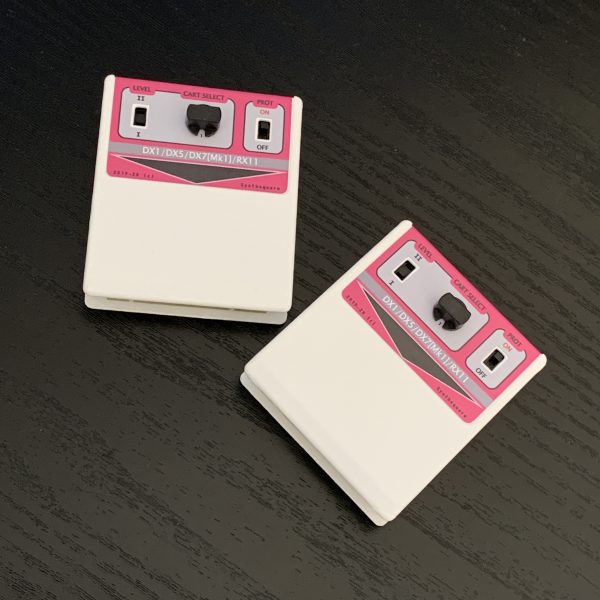
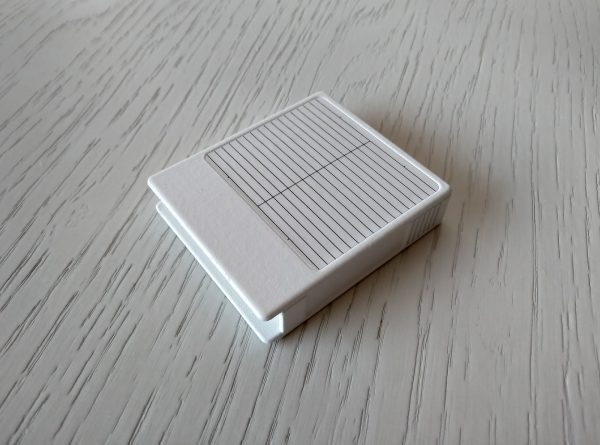
On the outside, the shape of the casing, even down to the small grooves on the sides to facilitate a firm grip, is identical to the original Yamaha carts. It is incredibly precise and it pretty much has to be. There’s no margin for error in ensuring the cart slots directly into place within your instrument of choice. The plastic casing is robust and, according to the maker, fabricated using an industrial manufacturing process. This is not 3D printed. I’ve had 3D printed cases for some of the SCSI2SD drives so I know how they look and feel. This is most definitely not the case. I don’t know exactly what the process is, but the materials and manufacture are spot on.
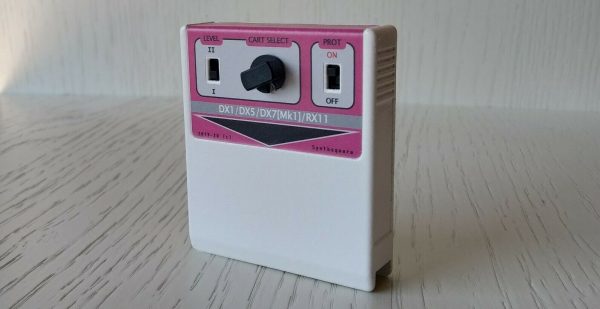
On the original carts, there was a 2-way switch. On the ROM carts, this switch selected which of the two banks the user wanted access to. On the RAM carts it was a write protect switch. On the Synthsquare units, both switches exist and both have the same purposes. Sat right in the middle of them is a small rotary knob with a small cutout on its flanged edge. In this gap, a digit is revealed to signify which of the 16 virtual carts has been selected. The knob is small but tactile and it has a very firm click between each step, which is reassuring.
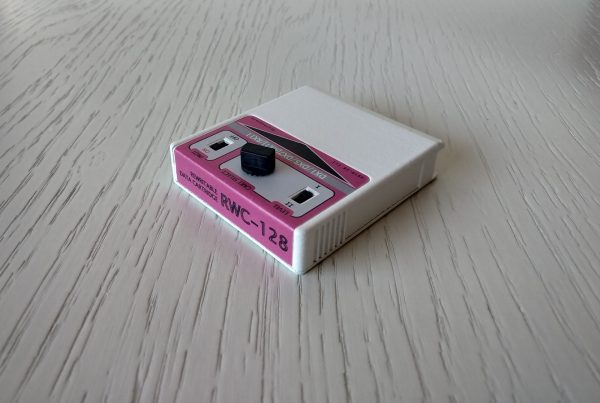
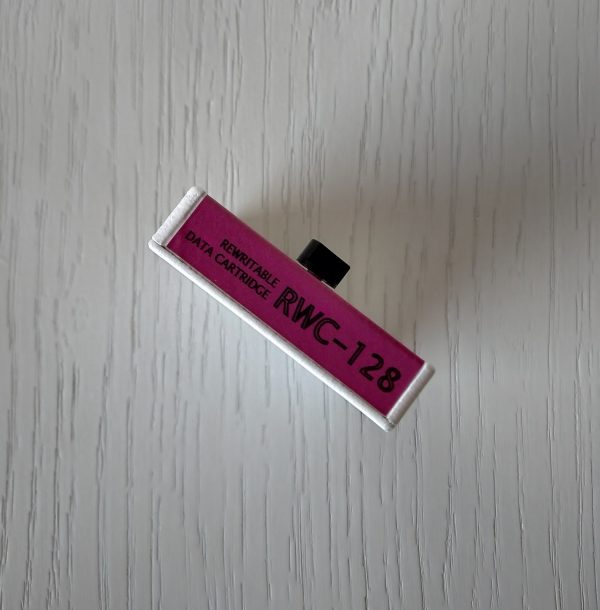
And, as the original carts had an area on the opposite side to write the contents on, so does the RWC-128.
IN USE
Operation is simple. One simply selects the cart number and then the “Level”, be it I or II. Each cart has two levels with 32 patches stored on each. 64 x 16 gives you 1024 possible voice patches stored on each physical cartridge. That’s more than enough for most people’s purposes, be it in the studio or out live. And if you have a DX1 or DX5, then you can use two to give you 2048 patches and a huge amount of patch-pairing possibilities for the Performance mode. One thing I am always wary of, even though the cart design of the originals is simple and sturdy, is the wear and tear that must inevitably take place when swapping carts over. With the RWC-128, this concern is alleviated a great deal.

So what are they like in use? Well, they work incredibly well, not that there’s much to go wrong here! I have tested both read and write functionality, as well as formatting, and the behaviour of these carts is identical to the originals in every regard. Switching between carts is seamless too. More on this a little later though. I had both carts set up in the DX5 and placed the original factory cart data onto Cart 1 of each. With the DX5 and DX1, Yamaha supplied 3 carts. 2x 64 patch Voice ROM carts (A & B) and a single 64 patch Performance ROM cart. The two voice carts contained copies of the factory internal A & B patch banks on their first “level” and a set of complementary A & B patch banks that were used in the dual/split voice modes within the Performance bank. So with the factory voice carts copied to cart 1 of the Synthsquare units, I still had 15 more carts to fill, although the carts come pre-loaded with 1024 carefully curated patches gleaned from the many thousands of DX7 patches available online. And each virtual cart can also be formatted as a Performance cartridge if one so desires, allowing a healthy combination of voice and performance patches to be contained on a single unit. It’s very liberating from having to send SysEx data to the synth’s internal RAM and then bounce it over to the cart and replace whatever it was you had in the internal banks again!

RESERVATIONS
And now for a couple of things I noticed that bothered me only very slightly. First of all, when the carts are inserted into the synth, the switches and cart selector knob are facing away from the user. Now, this was exactly the case with the originals although in those cases, it was only the level selector or write protect switch. With these new carts, it’s also the cart selector knob and, as such, it is impossible to see which cart you’ve selected unless you crane your head over the cart to look back or step out and venture round. A third alternative is to remove the cart and check, but this isn’t something I’d want to do every time. It negates the benefit of being able to leave the carts in place a lot longer than the originals and reduce wear and tear.
The other thing that became apparent quite quickly is that the carts are the same depth of the originals and, as such, this makes the turning of the cart selector knob a little awkward in certain positions. There’s not enough space between the cart and the top plate of the synth to get a fingertip under.
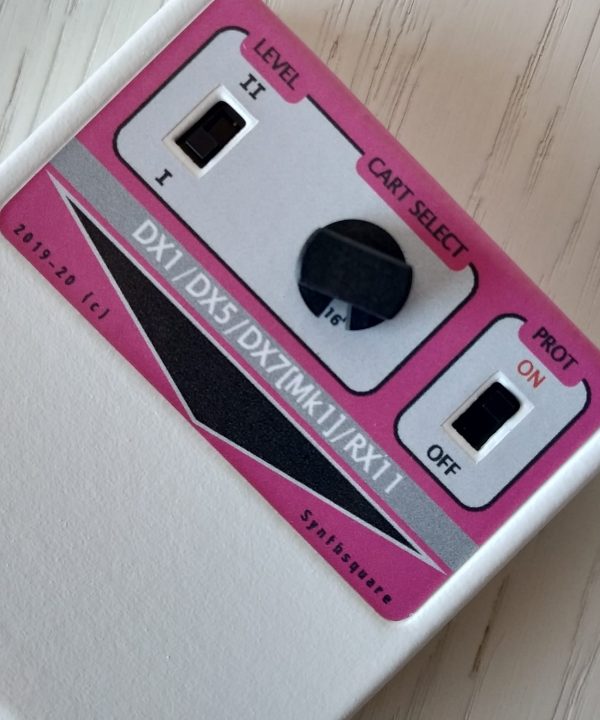
When I spoke with the maker, he was well aware of these two shortcomings and is already designing a new version that not only sits a little higher, but also has the controls facing the player. He hopes to have these in production later this year.
TECH SPECS
From a technical perspective, the RWC-128 uses EEPROM chips which allows for the same, simple circuit design of the original cartridge as well as removing the need for extra circuitry or voltage conversion. EEPROM chips do not require a battery to retain the data contained within them and each chip can perform enough read/write cycles to last a lifetime. The manufacturing process is 90% THT (Through Hole Technology) as opposed to surface mount, and each cartridge’s components are mostly soldered by hand. When asked about the choice of EEPROM capacity over certain competitors that can store great numbers of patches, the developer is of the opinion that 1024 patches is probably more than most musicians will need, and enough to store a variety of sounds needed for a performance. And he believes it is probably easier to remember what is contained in 16 carts rather than a few hundred.
It is also worth noting that the RWC-128 is also fully compatible with the original ADP-1 adapter that Yamaha produced to allow RAM1 carts to be used in the RAM4 cartridge slots found on the DX7 Mk.II, TX802 and DX11. However, as with the original cartridges, the ADP-1 will only allow reading of the cart, not writing to it.
CONCLUSION
So in conclusion, there’s not an awful lot to say here other than they work brilliantly, fit the bill perfectly and greatly expand the standalone capabilities of your instrument, removing the need to be tethered to a computer for SysEx dumps or to carry around a large number of carts and be continuously popping them in and out with all the wear and tear that brings. And for these facts alone, the two small issues mentioned earlier are rendered mostly moot.
From a personal perspective, these two carts are now my regular carts in my DX5. Over the coming weeks, I will load each of them up with my own personal collection of my favourite patches and performances

The cartridges can be purchased through Reverb or eBay for $139.90 plus $19.90 P+P via UPS. This equates to roughly £118 plus £18 P+P. Now, you may think, “Blimey! That’s a bit pricey for a small piece of memory in a bit of plastic”, and you’d be terribly wrong to think that. If you are in the market for DX7 carts of this size, you are looking at, on average, around £75 for a 64 patch original ROM cart, and much the same, if not more, for a 32 patch original RAM cart. I’ve seen many that are a little cheaper and plenty that are considerably more. So, the price of a single RWC-128, you can get, if you’re lucky, two or three original ROM or RAM carts. The RWC-128 saves you over £1000 over the cost of buying the equivalent capacity of original carts. In fact, it saves you nearly £2300 over the cost of buying the equivalent capacity of original RAM carts at today’s prices.
Doesn’t seem so expensive now, does it? 😉
You can buy the Synthsquare RWC-128 cartridges from the following locations…
eBay: www.ebay.com/usr/synthsquare.official
Reverb: www.reverb.com/shop/synthsquare
And you can find them on social media here…
Facebook: www.facebook.com/synthsquare
Instagram: www.instagram.com/synthsquare.official


Leave a Reply