


AcousticSamples VHorns – Review
AS reveal what they’ve been keeping under their HAT!
I’ve always been a stickler for authentic brass sounds. Brass tends to be one of the more uniquely expressive of instruments because the tone isn’t just about the instrument itself, or the player’s use of the mechanics, but also of the player themselves. The same trumpet can sound distinctly different in one player’s hands as it might with another. The physicality of the player is brought to bear quite prominently. And when it comes to replicating such instruments in synthesizers or samplers, it isn’t always as authentic as it could be.
I am a real sucker for big, French Horn ensemble patches, and pad-like brass sounds seem to be fairly easy to do in synthesis. But with individual performances of a solo instrument, the lack of nuance and accuracy becomes increasingly apparent. It was only when I bought my Korg Prophecy, in the mid to late 1990’s, that I discovered a solo brass sound that really nailed some of that nuance. This was most prominent when using the pitch bend wheel. Unlike most sampled brass patches up till that point, when you bent the note on the Prophecy, the model replicated the behaviour of the real thing and the bend stepped and you could almost hear the breath and tonguing. It actually sounded like the real deal and after that, nothing got close to authentic for me.
Of course, sampling has come a long way since then and the ability to meticulously sample instruments has allowed for infinitely more nuanced instruments to be created that display almost all of the sonic characteristics of the real thing. But companies like AcousticSamples are beginning to really blur the lines even more by combining both the art of sampling with the art of physical modelling and, as has already been evidenced in their VReeds, VTines and the B5 Organ instruments, it really delivers the best of both worlds. As well as vastly reduced file sizes (and therefore quicker load times), you get the truly authentic sound coupled with a truly authentic performance. This technology has now been brought to bear on VHorns, AcousticSample’s first foray into the world of brass. In a similar way to how Sample & Synthesis methods of the 90s utilised samples for the attack portion and digital synthesis to fill out the rest of the sound, AS combine samples as a sound source and then use modelling to create the rest of the performance.
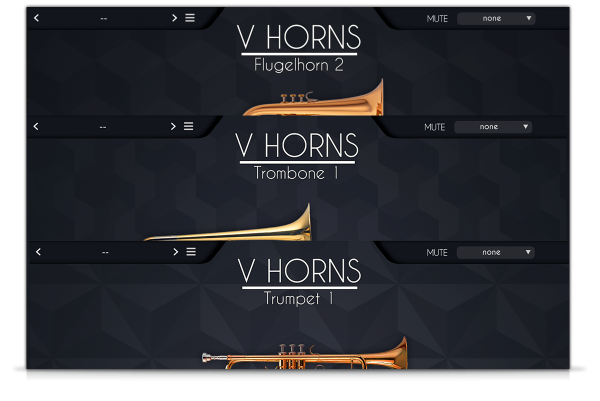
VHorns comprises of three instrument types and two versions of each of those. These are the Trumpet, Flugelhorn and Trombone. Each version of each instrument has been captured using different players to give you as much variety as possible. The following description applies to all three instrument types.
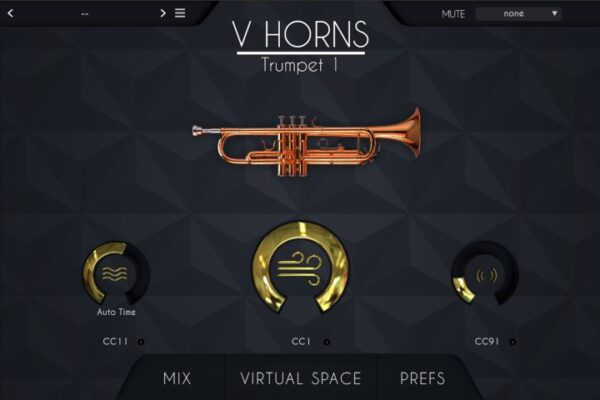
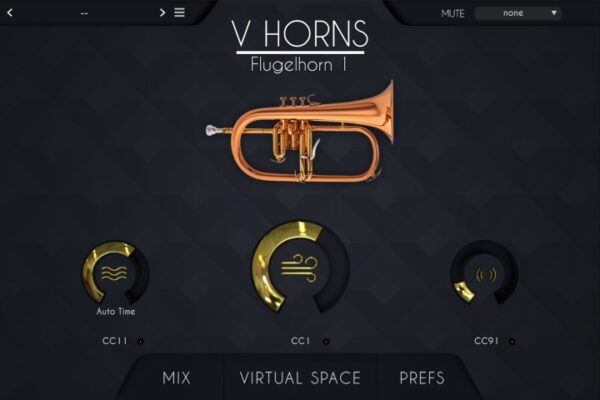
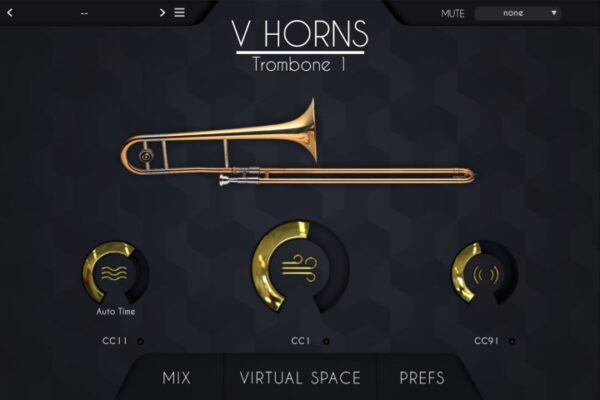
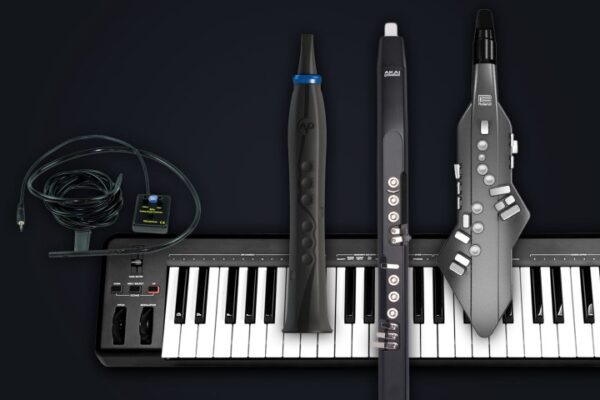
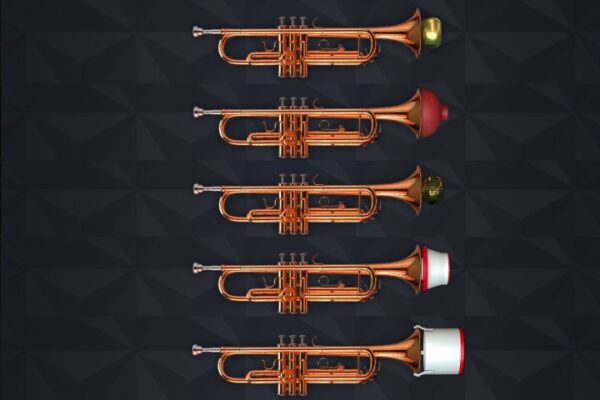
The interface is, as we have come to expect from AcousticSamples, clean, functional and very pretty. When you first load up the instrument, which is available in the UVI format and therefore fully compatible with the free UVI Workstation plugin or their hugely impressive Falcon instrument (which recently received a spectacular update!), you have a very simple interface that shows the instrument chosen (whose graphic is delightfully animated when played) and three adjustable parameters. these are Vibrato, Air & Reverb. Each of these can be adjusted via your pointer or via a controller that sends CC messages. Whilst each is mapped to CC11, CC1 and CC91 respectively out of the box, they have a ‘Learn’ feature which allows you to assign them to any CC-transmitting controller you desire. Top left, you have a range of presets to choose from as well as controllers so you can easily integrate this library with your AKAI EWI, Roland Aerophone, Berglund EVI, Aodyo Sylphyo or regular Breath CC controller. Top right is a selection of mutes to choose from with five different options.
But if you really want to dig in and customise, the three tabs at the bottom of the scripted interface are where you need to go.
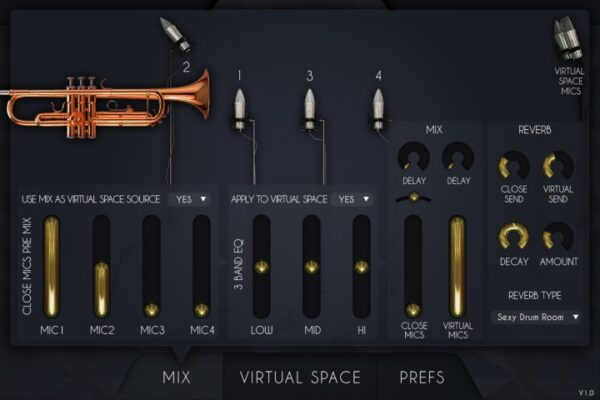
MIX allows you to adjust levels on up to four close mics, each at different distances, as well as blend between the close mics and the virtual space mics. EQ and reverb settings can be adjusted here too.
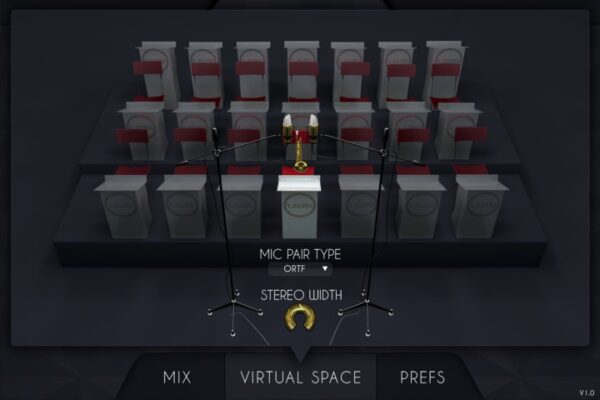
The VIRTUAL SPACE tab reveals a room with 21 different positions laid out in three rows of seven. At the front of this are a pair of virtual space microphones which offer five different mic positions, along with a width adjuster. This is great for placing your various instruments in a 3D space.
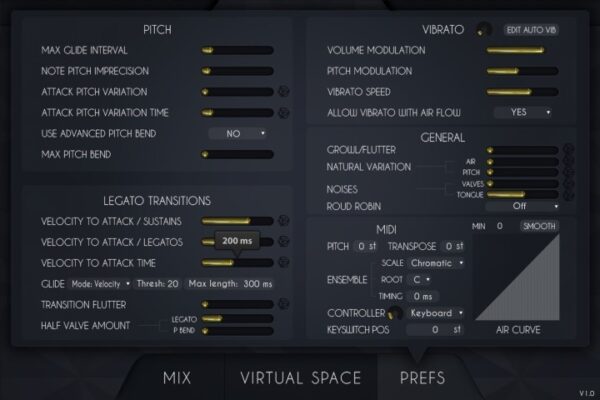
Finally, the PREFS tab is where one can really get into the weeds in terms of adjusting pitch variations and intervals, legato transitions, vibrato settings (including the auto vibrato settings), general features such as tongue noises, round robins, growls and flutter, as well as MIDI settings for controller types and ensemble scales.
AcousticSamples set out to create these instruments with no need to rely on key switching to move between playing styles and this is where their HAT (Harmonic Alignment Technology) comes in. This technology interprets regular MIDI inputs to deliver the right sound based on the performance input on the MIDI controller of choice, so the timbre of the instrument changes to reflect the velocity or legato inputs for example. It’s a system that seems to work very well indeed although, not being a brass player myself, I couldn’t comment on how accurate it is compared to the real thing. However, AS have created a number of real vs V Horns comparisons and to my ear, they sound almost spot on!
That said, a few key switches are still used for a handful of variations such as falls, doits or rises, note repeats and half-valves (pitched/unpitched). They have also included an ensemble function so that you can have up to four instances of V Horns instruments, all being triggered from the same MIDI track or input, but with varied timings, tunings and positionings to give you an ultra-realistic effect of a 4 part ensemble.
VHorns is an incredible feat of programming, seamlessly blending the two techniques of sampling and modelling to deliver an incredibly authentic and versatile sound without the need to learn elaborate key switching or develop a unique playing technique. I love anything that can make me sound better than I actually am and, once again, AcousticSamples have delivered stunning realism in a package whose price is criminally low!
You can buy all three instruments as the VHorns Brass Section or, if you wish, you can purchase each instrument individually to suit your specific needs. Quite frankly, why you would not buy the pack at the stupidly low introductory price of €149 (normally €199) is beyond me.
In a world where some of the big name players come up with far less inspiring content for twice as much money, I am eternally amazed that AcousticSamples and the UVI platform are not wiping the floor with them. The programming skills on display here truly show off the talents and passion of those behind VHorns and the amazing capability of the UVI platform.
Buy with the utmost confidence, and tell them I sent you…
VHorns Brass Section is available here… https://www.acousticsamples.net/vhorns for the introductory price of €149 until November 29th 2021 and €199/$229 thereafter.
VHorns Trumpet, Flugelhorn and Trombone are available at the following links for the introductory price of €79 until November 29th 2021 and €99/$119 thereafter…
https://www.acousticsamples.net/Bundles/vhorns-trumpet


Every time I playback midi file with vhorns plugein cuts out in certain areas and notes?
WTF!
Have you tried contacting AcousticSamples support? They are very good.