


ASM Hydrasynth
The Wavetable revival continues apace, with new kid on the block, Ashun Sound Machines
For years, we were bereft of decent wavetable synthesizers and now, it seems, we’re being inundated with them! And this is most definitely NOT a bad thing!
Last week seemed to be the week to announce such things with ASM showing their hand first, with Modal following swiftly afterwards with their ARGON8. Modal have already dabbled in this space with the delightful CraftSynth 2.0 as well as using wavetables in some of their other, higher-end synths, such as the 002.
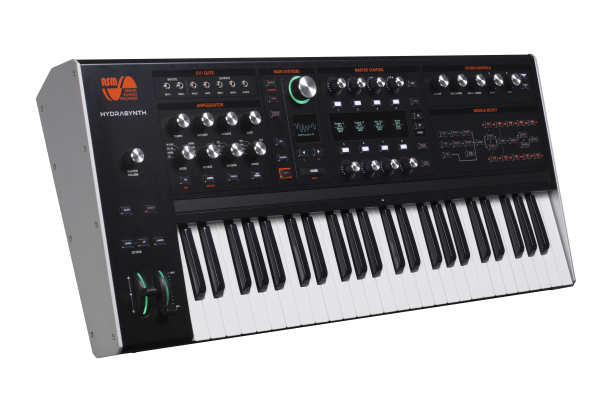
What makes ASM’s offering stand out, aside from the seemingly bowel-relieving sonics demonstrated in various videos and the way they managed to keep the whole thing under wraps for so long, is the fact that the Hydrasynth keyboard version features a poly-aftertouch keyboard and 4 octave long ribbon controller. To say people have been crying out for keyboards with PolyAT is an understatement and so it is little wonder that these two CS-80-esque features got everyone talking. Here’s the press blurb…
“Newly-formed music hardware company Ashun Sound Machines (ASM) is proud to announce (upcoming) availability of Hydrasynth — a wave morphing synthesizer representing its inaugural hardware product, produced as a keyboard version (featuring an ASM Polytouch™ 49-note polyphonic aftertouch keyboard and a user-assignable ribbon controller) and desktop version (with 24 velocity- and polyphonic aftertouch-sensitive pads, plus an included 19-inch rack-mount kit) — as of September 3…
Hydrasynth itself is an eight-voice, three-oscillator synthesizer anchored around a unique wave morphing synthesis engine. OSC 1, OSC 2, and OSC 3 can all make use of any one of the 219 single-cycle waveforms available, while Wave Scan mode (for OSC 1 and OSC 2 only) flexibly facilitates defining eight waveforms into a list and then morphing from one to the next using modulation sources.Said synthesis engine also features four mutators, allowing for further tonal modification. MUTANT 1, MUTANT 2, MUTANT 3, and MUTANT 4 have an ability to perform complex FM (Frequency Modulation) synthesis; each include three different types of pulse width modifiers, hard sync, harmonic sweep, and a Wavestack™ function that generates five detuned copies of the incoming waves for super-dense sounds. Furthermore, flexible routings within the mutators make available (almost) unlimited options for tweaking, twisting, and turning sounds inside out.
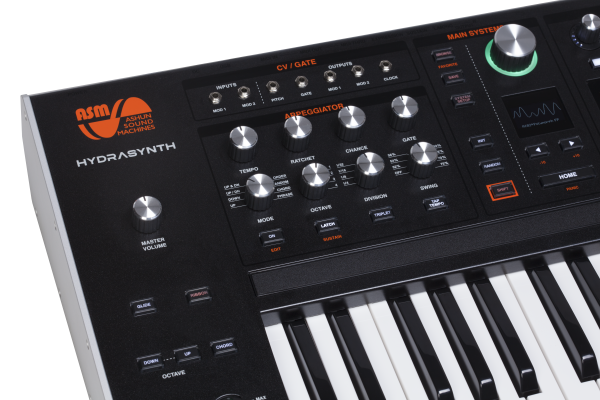
On top of that, the synthesis engine also contains two filters that can be configured in parallel or series. FILTER 1 features 11 filter models spanning new and classic filter modes, while FILTER 2 is a continuously-variable multimode affair.
As modulation sources add much-needed movement into a synthesized sound, Hydrasynth far from disappoints in that regard with five envelope generators — ENV 1, ENV 2, ENV 3, ENV 4, and ENV 5 — capable of looping as well as tempo synchronisation and five LFOs (low frequency oscillators) — LFO 1, LFO 2, LFO 3, LFO 4, and LFO 5 — capable of acting as step sequencers or one-shots. The modulation matrix — MOD MATRIX — offers 32 modulation slots with which to route sources to destinations. Such sources and destinations can also be received or sent via MIDI (Musical Instrument Digital Interface) CC (continuous controller) messages or front panel-accessible CV (control voltage) INPUTS and OUTPUTS.
Of course, connectivity to the wider world is as far reaching as it comes, courtesy of that full-blown MIDI implementation (via the usual connection compliment of MIDI IN, MIDI OUT, and MIDI THRU on five-pin DIN as well as USB) alongside CV/GATE connections (for playing nicely with the likes of today’s ever-widening world of Eurorack modular gear, vintage synthesizers, and more).
Hydrasynth has brought back one of the most requested features in synthesizers and controllers — namely, polyphonic aftertouch. As such, its unique polyphonic aftertouch keyboard breathes life and dynamics into otherwise static sounds, so users can create expressive musical passages using a standard-sized traditional keyboard. It is not necessary to learn a new keyboard technique to be able to play and perform with the Polytouch™ keyboard.
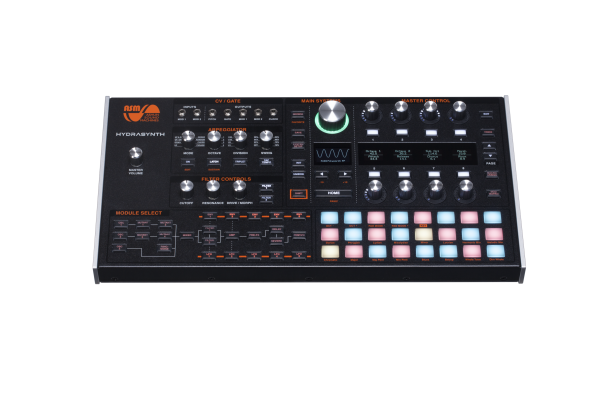
Alternatively, a desktop version of Hydrasynth — dispensing with that Polytouch™ keyboard and the user-assignable ribbon controller in favour of 24 velocity- and polyphonic aftertouch-sensitive pads — is available to those not needing to add another keyboard to their studio or stage setups; saying that, all other performance attributes are still at hand, including an adaptable ARPEGGIATOR and dedicated FILTER CONTROLS, with crisp OLED (organic light-emitting diode) displays duly providing welcomed visual feedback across the easy-to-follow front panels of both versions of ASM’s inaugural hardware product… when it comes to working with a sensational synthesis engine, the choice is out there!
Expected to ship in November 2019, Hydrasynth will be available through ASM’s growing global network of authorized retailers at an MSRP of $1,599.00 USD ($1,299.00 USD MAP) for the keyboard version and at an MSRP of $999.00 USD ($799.00 USD MAP) for the desktop version.
For more in-depth information, please visit the ASM webpage here: http://www.ashunsoundmachines.com“
So, Hydrasynth is getting both a keyboard and keyboard-less desktop version right off the bat. And that pricing is very aggressive and welcome for something that sounds as huge as this thing does.
I am reliably informed that ASM are associated with Medeli, a manufacturer with whom you may not be familiar straight away, but whose handiwork may well be inside some equipment in your studio already. I know for a fact that they have worked closely with Alesis in the past on their eDrum kits. You only need to check out some of the Medeli-branded drum kits to see the striking similarities.
What bearing does this have on anything? Well, it means that ASM should be well backed, both financially and technologically. And they have Glen Darcey on board too. You will probably know that name from his previous engagements with Arturia and Akai/Alesis. Our paths crossed back in those early days of the “new” Akai after Jack O’Donnell bought them out and brought them into his InMusic group. He’s a passionate and dedicated player in the industry and he will be key to ASM’s future success, I am sure.
So all bodes well, for ASM and what a machine to launch with! I am hoping to get hold of a review unit in the very near future, so watch this space!


Leave a Reply