


Modal SKULPT & CraftSynth 2.0 – Review
Modal bring their unique synthesis vision and skills to the burgeoning tabletop synth market
If there’s one thing in the synth world we can’t seem to get enough of just lately, it’s tabletop synthesisers. They’re practically falling off trees at the moment with every synth manufacturer keen to get in on the act and corner a piece of what is fast becoming one of the most popular and, in some cases, most innovative areas in electronic music. Whilst small, battery powered synths are by no means a new thing (Stylophone, anyone?), it looks like there is a definite race to see who can cram the most into a tiny, portable box and maintain a big sound and intuitive functionality.
The recent spate of gear in this segment seems to have started when Korg launched their incredibly successful range of Volca units, each with a very specific function and deliberately kept to an affordable price point. I think it would be fair to say that many young people’s first synthesis experiences were with Volca’s. Roland followed suit with their very hit-and-miss Boutique range. Yamaha launched what I thought was a slightly odd take on the genre with their Reface series but it seems to be the smaller companies that are making the biggest and most daring waves. In the last couple of years, IK Multimedia have wowed us with their UNO Synth and recently released UNO Drum, both analog, both diminutive in size and both sounding far bigger than their physical size would indicate.
And now British synth manufacturers Modal Electronics have dipped their toe in the water with two innovative and unique synthesisers, the SKULPT and CraftSynth 2.0. The latter has a version number because it is a follow up to a previous attempt at this market that caught a lot of people’s imagination but never really set the world on fire. The original CraftSynth, along with the CraftRhythm, were small, self-build units that consisted of around four pre-built PCBs and a set of snap-on rotaries and buttons. Each unit could be assembled in around five to ten minutes and once powered up, could deliver some rather natty sounds. But these were delicate creatures, their innards exposed to the elements and random fluid contamination! These seemed like a small folly by a manufacturer better known for producing the 002 and 008 synthesisers that boasted some immense DSP and analog synthesis engines at a rather hefty, but not unwarranted price tag.

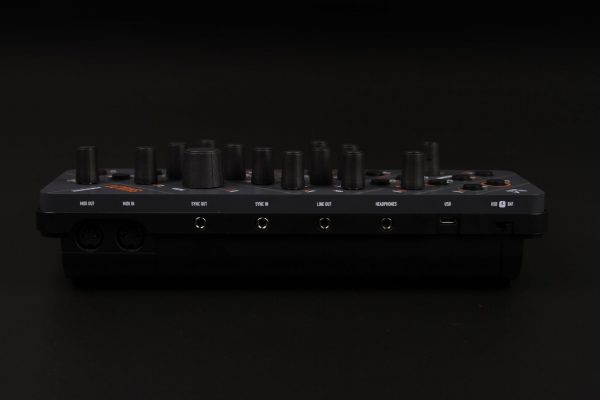
But now, Modal have stepped up to the tabletop market properly and have released the SKULPT and CraftSynth 2.0, both encased in sleek and modern plastic housings, featuring USB and battery power options, full size MIDI ports, headphone and line out audio connections and a pair of 3.5mm Sync in and out sockets. Both units feature a touch sensitive playing surface that also doubles (or triples) up as function keys, as well as containing LED indicators to deliver some feedback to the user regarding settings and levels. Similarly, both units feature a battery compartment located at the rear of the unit that also doubles up as a stand to tilt the control surface upwards. And those control surfaces are very similar too. Each of them feature digital rotary encoders laid out in a very unique way and almost all of which have more than one function, selected by use of a shift key. Where the SKULPT’s keyboard resembles the common chromatic keyboard layout, the CraftSynth 2.0’s keyboard relies on a range of preset chromatic scales, which is quite common these days.
But that’s where the similarities end. SKULPT is almost twice the width of the CS2 and even comes with its own hard plastic case that can double up as a stand to render the control surface flat as opposed to pitched (CS2 came with a semi-soft case for Kickstarter pledgers, but a case for everyone else is anticipated this fall, priced around the £20 mark). But the biggest difference is the synthesis methods and polyphony. SKULPT is a four voice polyphonic VA synth with thirty two oscillators (eight per voice) as well as FM & PWM options and a ring mod. Two audio rate LFOs that can operate synced with tempo as well as frequency divisions, an eight slot mod matrix and three syncable envelope generators (amp, filter and modulation) beef up the spec, with a resonant and morphing three mode filter and flexible sequencer and arpeggiator.
CraftSynth 2.0, on the other hand, is a monophonic wavetable synth with eight oscillators and forty wavetables to select from, some of which come directly from their 002 synth. It too features the morphing filter, twin LFOs, syncable triple EG’s, Mod Matrix and unison modes as its bigger brother.
Both synths are supported by Modal’s free, cross-platform ModalApp, allowing for much more detailed tweaking as well as being available as a VST3 and AU plugin for seamless use of the hardware via your DAW of choice. Sadly, VST2 support isn’t handled, so is you’re like me and use Reason as your DAW of choice, you will have to sit this party out until the recently renamed Reason Studios finally see sense and add VST3/AU support. Yes, that was a small hint to my Swedish friends 🙂

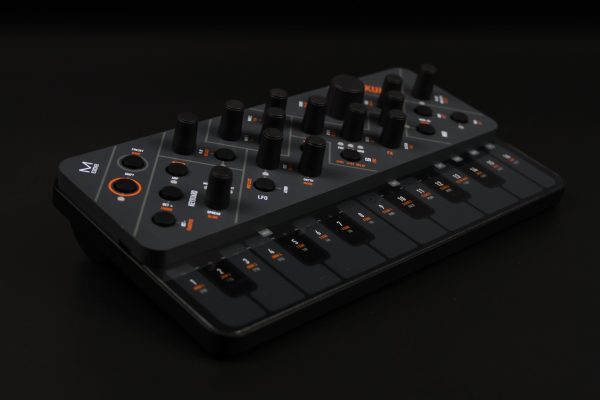
When I was first given these units to review, I was more keen to try the SKULPT, as it was a polysynth and that is something quite rare in this segment. Regular readers of this site will know that I was rather disappointed by the Roland JP-08, their Boutique Jupiter 8 clone that boasted only half its inspiration’s voice count. The SKULPT is the same, but at least it was designed that way and, like the JP-08, it can be poly-chained to great effect. Two SKULPTs would cost considerably less than two JP-08’s, and I’d wager you’d have more fun with the SKULPTs too. Sadly, as Modal only provided me with a single SKULPT (and very grateful I was too!), I can’t report on this specific feature. But right off the bat, SKULPT betrays its diminutive physical structure and sounds mightily impressive.
There is no mistaking the fact that despite its small stature and price point, SKULPT sounds as big as the vastly more expensive 002 synth. There is little sonic compromise, although the is a big difference in terms of feature sets, as one would expect. But like many synths in this segment, size is most definitely not everything and flicking through the presets, of which there are over 100. you can very quickly tell that this is a very capable unit. Once you’ve familiarised yourself with how this thing can sound, you will want to dig in to making your own sounds and there are plenty of options for you to choose from with which to shape that sound. Which brings me to my only slightly less positive comment on the SKULPT. The control surface is quite resplendent with fourteen rotaries and thirteen buttons, as well as the multi-function chromatic keyboard section that offers more settings, but the layout is far from obvious. Modal have gone for a very angular, non-conformist approach. All of the nomenclature is slanted at 45º and the font used is quite small. The unit itself is black and the text is either white or orange. Now, orange is by far and away my favourite colour, and orange and black work very well together, but maybe not so much here. Bearing in mind that many musicians work in low light levels, either deliberately or otherwise, it’s not so easy to read the text on the unit and for older people with ageing eyesight like me, I found it hard to quickly find what I wanted.
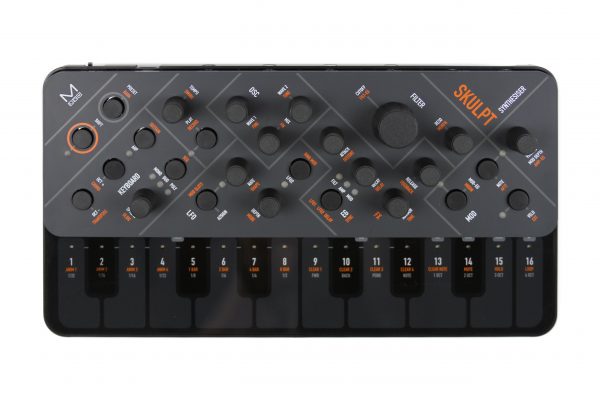
Add this to the fact that the angular layout is not like anything else I have used, synth-wise, I sometimes struggled early on to find what I wanted. One of the reasons I love the ol’ SH-101 or Model D layouts is that every control runs left to right in the same way the signal chain works. Not so with the SKULPT. Another thing I noticed from using the SKULPT in low light levels was that the LEDs were rather bright and whilst this might not be a drawback on many synths, on the black SKULPT, the glare was enough to cause my pupils to expand enough to require some adjustment to then read the labelling close by. An LED brightness control might be useful here. Now, I’m not saying it is wrong, because as far as I know, there is no rule book on the nomenclature of synthesisers, but it seems that to cram all the necessary and required controls onto the surface of the unit, Modal “may” have gone more for style than practicality here. This is not to say that you won’t learn it, and become proficient at using the SKULPT, but it will take some extra effort to get there. It’s not a biggie, but it is definitely worth noting.
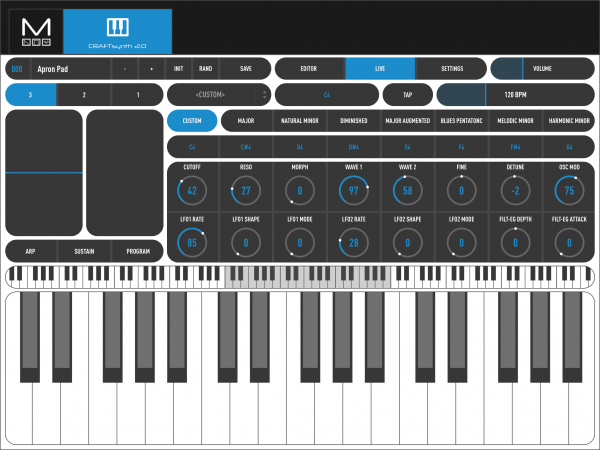
However, fire up the Modal app or plugin and you are then presented with a far more attractive way to access the features of the synth. So much so that I soon found myself using the app almost exclusively to mess around with settings. I do like good, informative visuals and the app truly excels at this. Every aspect of the synth is clearly laid out, easily understood and delivers all the information feedback you need. As an Instructional Designer by trade, I understand the importance of clear, consistent and understandable visual design. If you tie up the brain with other things like having to adjust to wonky text or picking out colours that clash, you take away valuable cerebral processing power to be able to focus on the job in hand. And the app has to be highly commended here. I do like this recent trend of companion apps to these tabletop synths, particularly when they come as a VST/AU plugin like this. The ability to write automation to the plug in and control the hardware directly from the DAW is the kind of interaction I dreamed of back in the nineties. Back then, you had to figure out all the appropriate MIDI CC numbers for each piece of hardware and it was all very confusing. Here, it is so much easier and I honestly believe that every hardware synth should come with a companion app such as this. And even though I have only ever lightly dabbled in the world of making music with iOS, the benefits of having a touch-enabled app is immediately obvious. When every control has two or more functions, it is difficult to know exactly where you are. I know that if you’re trying to cram a powerful synth into something the size of a paperback book, you’re going to have to make some compromises, and I am sure that everyone that spends some solid time learning the workflow will be able to pick it up quickly, but I just wanted to highlight that the SKULPT will take some getting used to, so do persevere, because the sound it makes is very much worth it.

And about that sound. It is very, VERY easy to start from an init. patch and get something really wild within seconds. Using the Randomise feature is a really quick way to get the creative juices flowing. The sheer breadth of features delivers a great deal of scope for shaping your sounds, or tweaking presets. There has been no compromise in this regard and this is the benefit of such DSP based synths. The ability to cram a ton of features in without breaking through that all-important price-point is enhanced when going down this route. If you wanted a genuine analog synth with this much sound-shaping capability, you’d be using something at least twice as big and probably four times the cost.
From scything leads, to lush pads and globulous basses, SKULPT delivers on all fronts. The sequencer and arp provide some really useful creative tools but I do feel that they have cut a few corners here too. Whilst the sequencer can store up to two hundred and fifty six notes, it only has a mere four automation ‘lanes’. Compare this to something like IK Multimedia’s UNO Synth that can have up to twenty lanes of automation recorded, it feels a bit mean, but then the UNO Synth can only currently do sixteen notes on the sequencer. Again, to hit the ideal price point, things like this are always going to be an issue. But if you consider that you may only use these elements when you’re out and about, it shouldn’t cause too many issues and when you’re back in the studio, you can use something more capable to sequence with. Certainly, the SKULPT provides plenty of space to get ideas down.

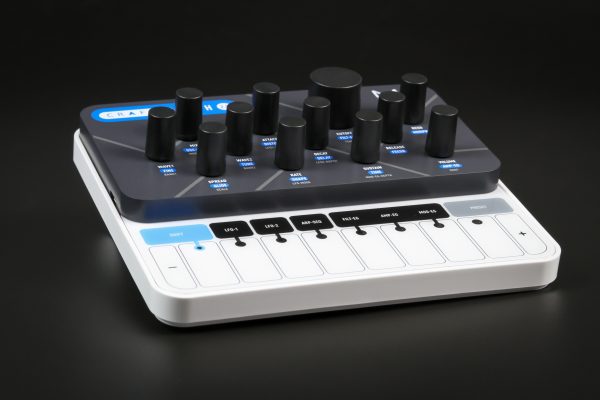
Bizarrely, when I got both the units, I thought it would be the SKULPT that I would be seduced by more, given that I had been craving something small and polyphonic, and as much as I was impressed with it, and would struggle to part with it, the CraftSynth 2.0 (or CS2 from hereon in) was the one that really turned by head. Maybe it’s because I have been playing with more monosynths of late, but I spent more time with the CS2 than SKULPT. Only a little, but definitely more.
Stylistically, the CS2 shares much with the SKULPT. It is obvious they are related, design-wise. But the CS2 is, as you’d expect, smaller and has less direct access controls. But, most importantly, the layout is better. There seem to be definite rows, although not as I might have hoped. For example, the ADSR controls are still laid out in a ‘V’ shape but because the nomenclature is horizontal, and all in white, or white in blue boxes, it is very easy to navigate and doesn’t suffer from some of the issues I remarked on with the SKULPT. I suppose the simpler the synth, the simpler the controls.
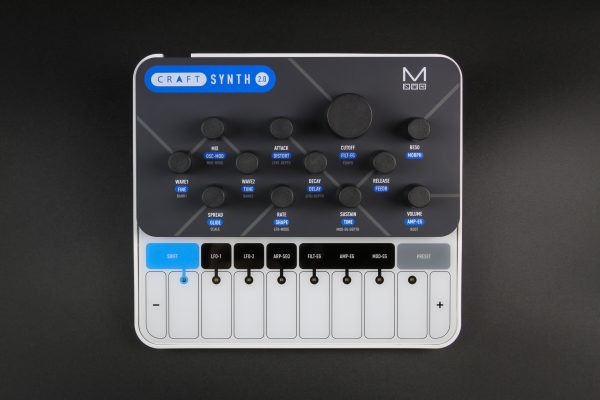
CS2 uses wavetable synthesis as its sound generation source and there are some great wavetables to use here. Everything from VA to digital to stuff straight out of the Modal 002 and with the ability to set five wavetables in up to eight banks, all of which are able to be morphed, you can get some idea of how capable this little box is.

One of the first things I noticed with CS2 was how big it sounded. I guess I’m still not used to huge sounds coming out of little boxes, but there is also a width and depth to the CS2’s sound that betrays its monophonic capabilities. All of those oscillators can deliver multi-tonal sounds that can deliver some impressive pads as well as the leads and basses you’d typically expect. It really is a very capable little package and devastatingly powerful in its sound.
Like the SKULPT, it has a capacitive touch “keyboard” except, as I mentioned before, it is not of the traditional piano-like layout but instead it just provides eight “pads” that can follow a variety of musical scales, of which there are twenty nine (you can assign any seven of these to quick access slots), with room for a custom setting. The user can also pick the root of their chosen scale across a massive ten octaves. And again, like the SKULPT, the fabulous ModalApp delivers a much better level of detail on the workings of the CS2 with a ton of visual feedback and the live performance screen that allows rapid access to features that benefit the live performer. I imagine (I have to say imagine as I don’t have a modern iPad to try it on) that pairing these synths with a large screen iOS device would be a lot of fun.
Demos
In Conclusion…
Both of these units are a huge amount of fun and both deliver a depth of sound and level of control that is way beyond what you would expect from instruments of this size and price. However, I feel that the depth of control offered by the SKULPT is hindered by a UI that is a bit too radical for instant fun. It takes some commitment to learn and adapt but, in its defence, once learned, it is entirely rewarding. I’m all for manufacturers breaking moulds, but not necessarily at the expense of ease of use. One of the first things I do when reviewing new gear is dive right in without even referencing the manual. With the CS2, I was able to feel at home and make really fun sounds very quickly. The SKULPT, not so much. But after a while I “got it”. And once that happened, I was able to coax some really nice sounds out of it. I do have to point out that Modal supply “crib sheets” with each of the units that outline a range of UI combinations to help you learn their workflows and processes. Useful as these are, the fact they are required does add weight to my thought that UX was slightly compromised in favour of visual design.

The ModalApp also helped a lot! I’d love it even more if it had six or eight voices too. I have a habit of playing three note chords with a root bass note or two and I found that the restriction of four note polyphony meant that with my decidedly sloppy playing, I occasionally noticed the notes being dropped here and there, but that’s no fault of the unit, just a limitation of the spec and my crappy keyboard chops!
If truth be told, I have been totally seduced by these little boxes. They look the part and definitely sound the part. One thing that put me off getting into Korg’s Volcas was that, at a glance, they looked like Stylophones with some extra knobs on. Of course, this isn’t the case and they’re all very capable little boxes, but these Modal units exude class and benefit from this visually. And sonically, they sound as good as you would expect from a manufacturer that prides itself on innovative and powerful synthesisers.
I’d like to try some other things out, like hooking the Sync ports up to other bits of third-party gear and playing around but I lack that equipment right now. I did set up a little chain with the IK Multimedia UNO Drum providing beats and a clock over regular MIDI and that was a lot of fun. I never fail to be impressed by the fact that we can now all access top quality synthesis engines in such small packages and at such low prices, and the icing on the cake is the powerful app/plugin integration that allows this hardware to seamlessly blend into our “in-the-box”, twenty first century music making practices. It truly is the best of both worlds.
I will be VERY sad to have to send these back as I’ve grown very fond of them and they have taken pride of place on a shelf that is now full of these little tabletop gems. I wholeheartedly support companies like Modal who are successfully addressing both ends of the market without compromising on quality and ingenuity. They’re being bold and brave and we are very much benefitting from that.
SKULPT and CraftSynth 2.0 are available now from all good music stores, and some bad ones too.
CraftSynth 2.0 is on sale now at £129.99 and SKULPT retails for £269.99. The ModalApp and plugins are free to download from the Modal website or via the Mac, iOS and Android App stores. There is also a free ‘Stranger Things’ inspired sound pack and MIDI file available for free from the Modal site…


Got one, great sounds, especially the ones I spent hours making. 3 weeks after it just died. Nothing worked, nothing will. Customer service advised me to buy a new one to ”get around the problem”!!! Just money down the bin. Don’t bu this might as well burn £120 and sample the burn sound
That’s never been my experience of Modal support and does sound odd. If the item is still under warranty, you should return the unit to the original retailer with the receipt. If they can’t help you, and there is still a warranty, Modal should help you. I’m sorry to hear your experience was less than satisfactory.