


BBC Symphony Orchestra by Spitfire Audio

Despite decades of electronic music, the onslaught of samplers and sampling technology and every naysayer and doom ‘n’ gloomer predicting that computers would replace musicians before the 20th Century was out, orchestras are as popular as ever and, it would seem, sticking a middle finger up at all those who wrote them off.
Ok, so I know I’m probably being a bit glib, and some orchestras have been dissolved, more by a lack of adequate funding of the arts in general by various administrations around the world than by a proliferation of technological replacements, but orchestras are still providing us with deep, complex and rich sonic performances and I strongly doubt that will ever change.
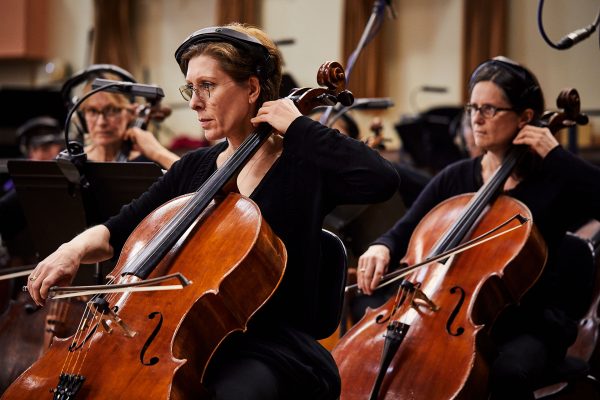
But over the years, as we have sought out more ways to accurately replicate the intricate and almost infinite range of articulations that 70 to 100 people can make with some fancy wooden boxes, strings, metal tubes and hollowed out tree trunks, some developers have managed to almost fit that genie into a plug-in shaped bottle. Advances in scripting technology, a proliferation of large digital storage devices and exponentially powerful central processing chips have edged us ever closer to having something that could possibly be considered as a replacement for a real, live orchestra. So much so that we are now spoiled for choice and can pick a tool that suits our budget, our project needs and our storage capacity. Legend has it that one Hollywood composer used to have more than a dozen high-spec PC’s running his ‘virtual orchestra’ so that he could compose as closely as possible to the real sound before decamping to a large studio filled with actual people to lay down the score.
These days, we find ourselves surrounded by super-powerful computers and ever increasingly capable tools so that we no longer need the likes of a server farm. And Spitfire Audio’s BBC Symphony Orchestra now aims to be the ubiquitous tool for composers sans orchestras. And its aim is true…
Until the back end of last year, I knew only of Spitfire as a sample library company that catered for people way more skilled and ambitious than I. Predominantly focused on orchestral libraries with specific themes, be they sonic, visual or collaborations with composers, I simply had no need (and no budget) to indulge. I did, however, avail myself of their free LABS collections, a truly altruistic and generous service that provides small, focused but beautifully formed sample packs with a unique spin. They feel almost as if the developers at Spitfire have collated their little side projects and then offered them up as little teasers. A clever marketing ploy, maybe? But it is one that enables the company to quietly expand their audience and attract new customers in the process, whilst building a sense of community and togetherness. And this ethos literally explodes into life with the BBC Symphony Orchestra (BBCSO).
What I mean by that is that one of the overarching sentiments behind BBCSO is one of a community. A place of nurturing and fraternity that removes that sheen of snobbiness that often surrounds such companies and such products. And it was these sentiments, these feelings, that really struck me about BBCSO when I first began exploring it back in November 2019.
I am not a skilled musician. Not by a long stretch. Like many, if you give me a computer and some tools, I can fashion a decent tune, but I am not a skilled musician. Nor am I a skilled composer. Most definitely not. So it might seem strange that I was given the opportunity to review the BBCSO package. Surely this should be reviewed by a skilled composer with a grounding in music theory and composing for an orchestra? I would agree, but then I’ve always thought that the mark of a great tool is that beginners and professionals alike can make something worthwhile with it.
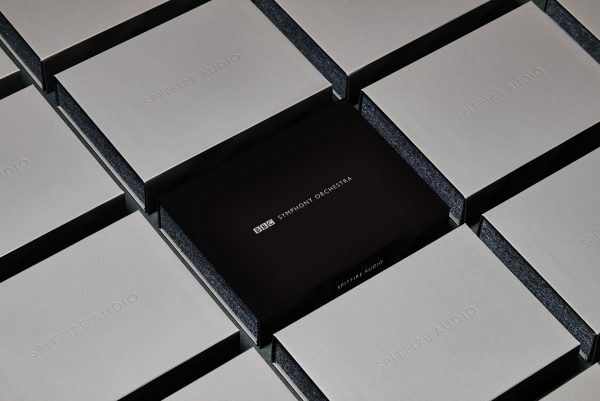
The first daunting experience was to download the entire library. When I received BBCSO, there was only the one version. This has recently been added to, but more of Core & Discover later. The Pro version, as it is now known, has a library that tops out just under the 600GB mark. You can choose to download this, using Spitfire’s own library management tool, or for an extra £249, they will provide the library on a very sexy-looking 1TB Samsung SSD drive that has its own custom BBCSO case. I’ve seen one of these in the flesh and it is a beautiful digital trinket and a true objet de desire. But alas, small-time reviewers like me have to forego such luxuries. And, thankfully, a decent fibre connection makes small work of this chore and I was up and running in no time. This is also helped by Spitfire’s sensible breaking up of the library into its main parts, each with their own separate download.
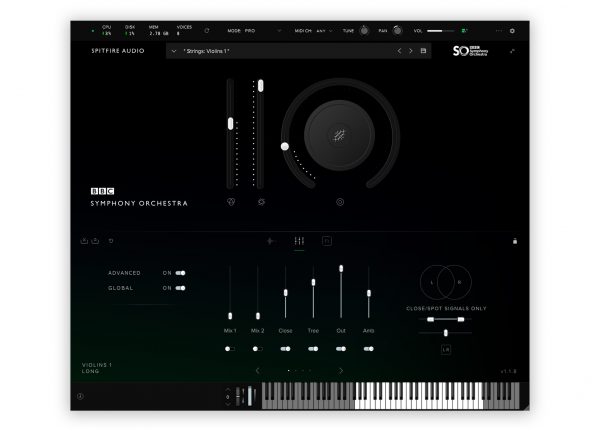
Once installed, the plugin exists as a VST2, VST3, AU and AAX plug-in, so you will be catered for whatever your DAW. Spitfire have chosen to use their own, rather excellent plug-in, which has been designed by games company ustwo (Monument Valley, DICE). It is delightfully uncluttered, simple and intuitive and, if I may be so bold, a gazillion times better than a Kontakt interface. There are no elaborate graphics, no fancy pictures or lots of drop down menus. It is an efficient interface designed for work. A subtle and dynamic help system is built in that explains what all features do and mean when you hover over them and there are easily MIDI-mappable visual performance elements that give you control over the most important aspects of playing orchestral instruments using a piano-style keyboard, such as dynamics, vibrato and articulation.

If I were a working composer, competent musician and someone for whom using BBCSO would be a daily thing, much like a carpenter uses a saw or a chef uses a pan, I’d begin to wax lyrical about whether the tools and the sounds covered all conceivable aspects of scoring for an orchestra, how it enabled me to fully realise an orchestral piece without the need to hire an actual orchestra and recording space and how I could pitch my work more completely than ever before. But I’m not, so I shan’t. But I’ll tell you this for nothing, I have a few orchestral libraries, ranging from the Prosonus ones on the Series III Fairlight CMI to more recent, scripted affairs in Kontakt and UVI formats, and a whole bunch of stuff on my Akai samplers and none of them come even within the Maida Vale postcode in terms of authenticity, expressiveness and quality of sound.
In use, it is pretty straightforward to navigate all the options. The mark of a great design is one that is instantly intuitive and rewarding. BBCSO is such a design. Within minutes, I was discovering all the playing styles and, more importantly, the techniques required to coax these out of your virtual orchestra. A sample library of such depth and intricacy will always require the user to learn it as they may a new instrument. BBSCO is no exception, but it is by no means a chore.
BBCSO is not just about the audio or UI quality though. No… it is about accessibility, democratisation and empowerment. It is about a universal starting point. I mentioned the excellent community that Spitfire have created which is headed up by ‘The Page‘, a mini-site that provides templates, tutorials and stories centred around the BBCSO suite. Create a piece of music, share it online and use the #oneorchestra tag and it will be seen by a ton of like-minded individuals and possibly even featured on the site. You can also avail yourself of free templates for most of the popular DAW’s, download MIDI files so that you can deconstruct many pieces and fully learn how to use BBCSO.
But you may ask yourself, “This is all very well, but I simply can’t afford this tool, priced as the Pro version is at £899, so how can I even begin to contemplate being a part of this?” That is, admittedly, a large chunk o’ change and, when you consider the content in every aspect, it is actually great value, yet out of the reach of many people. This is where BBCSO really breaks the mould.
Earlier this year, Spitfire expanded the range to include two new variations of the BBCSO library; Discover and Core. The existing version was given the ‘Pro’ suffix and it remains the complete package. What Discover and Core do is cater for all budgets by judiciously trimming the content back in ways that do not break the quality of the sound, but make the investment in the bigger versions very worthwhile.
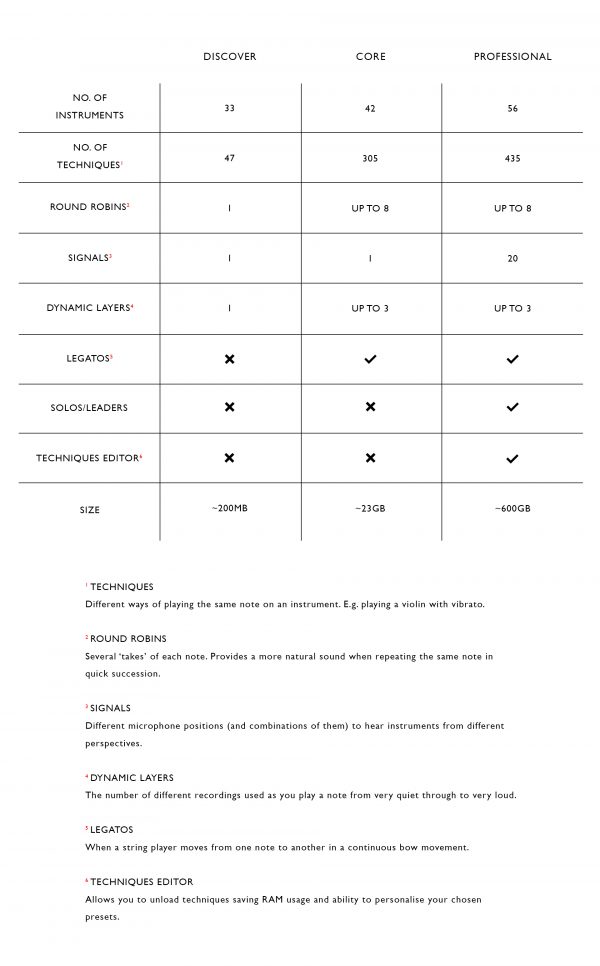
Spitfire Audio’s Paul Thomson explains the key differences here…
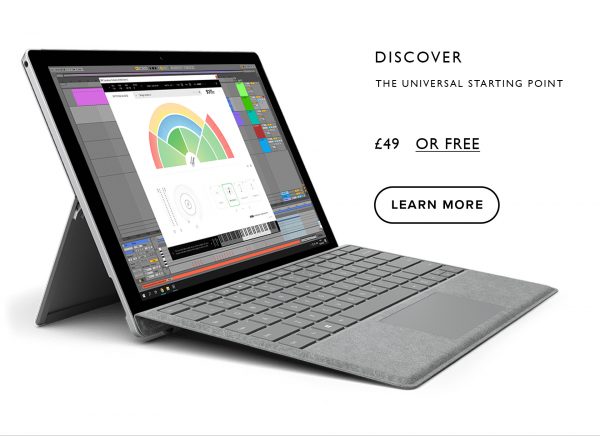
Discover is the entry level point. At just over half the instruments contained in Pro and, by comparison, a minuscule library (~200MB), it delivers a set of basic tools using a selection of samples. Whilst it does not have anywhere near the number of techniques or samples, and is limited to a single round robin and dynamic layer, it has enough to be entirely useful and capable of producing some very authentic sounding compositions. Discover costs £49 or is completely free of charge if you are willing to participate in a Spitfire Audio market research survey and then wait 14 days for your link to arrive.
This is how good Discover sounds…
Core, on the other hand has a much increased set of tools, many more techniques, up to 8 round robins and up to three dynamic layers and rocks up at ~23GB worth of sample content. It also adds legatos. This version is a very reasonably priced £399.
Besides this being a great way of opening up the library for all, the genius part of it is that all three libraries are interchangeable, in that one can compose a piece in Discover, send it over to someone who uses Core or Pro and the plug in takes care of the mapping into these larger libraries. Conversely, compose something in Pro and send it to a Discover or Core user and the plug in ensures that everything is mapped sympathetically to the smaller libraries. For example, my 14 year old son has Discover. He can create something with it within the Logic environment and send it to me. O can open it up in Pro and it will sound exactly the same and will allow me to build on it. Likewise, I can compose something in Pro, send it to the lad and it will sympathetically map it to the Discover library, albeit missing out the Pro exclusive features. But it will sound very similar and will be enough for him to pick up the ball and run with it.
Another useful aspect of this functionality is one that allows an individual to have Pro installed on their studio system and then install Discover or Core on their laptop and allow BBCSO to facilitate work on a single piece across two computers with sensible hard drive footprints.
It is utterly inspired and really and truly lives up to, nay DEFINES, the ethos of inclusivity that Spitfire launched BBCSO with.
Spitfire have truly redefined orchestral libraries with BBCSO, way beyond the realms of sheer quality and ease of use, with a singular ambition of preserving a musical institution and at the same time, delivering a superb tool that has something for literally everyone and every budget.
I genuinely cannot find fault with BBCSO, but even if it was half the library it is, the way that Spitfire have gone beyond the tool itself and fostered a community spirit is possibly the most important feature that BBCSO has.


Leave a Reply